Cardboard Pallets for Fresh Produce Export: Weight, ISPM 15 and Logistics
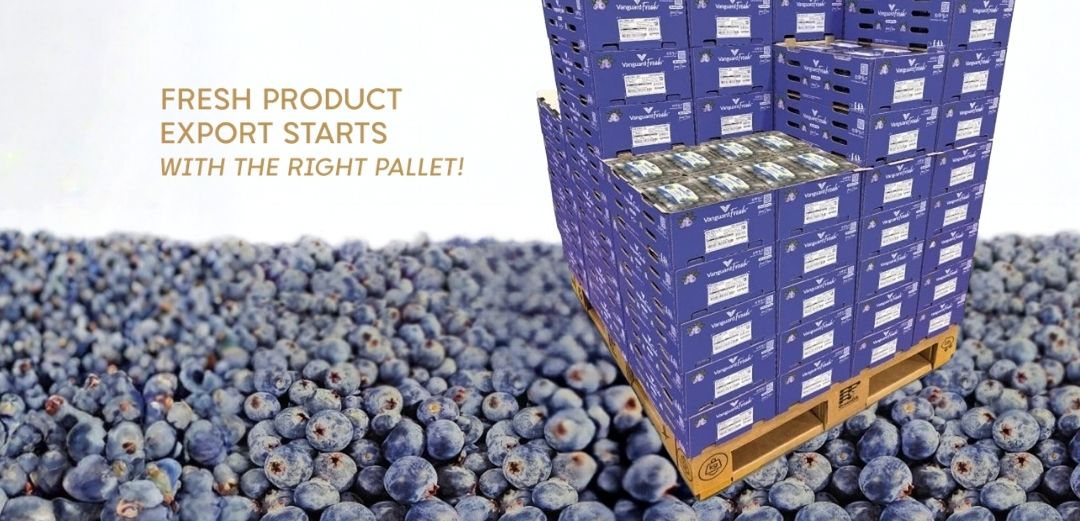
Fresh produce exports operate under demanding logistics conditions. Transit times are critical, international routes can be complex, margins are tightly controlled and packaging has to protect products throughout handling, storage and transport.
In this environment, the pallet should not be treated simply as a platform underneath the cargo.
The type of pallet used can influence auxiliary shipment weight, phytosanitary requirements, warehouse handling, freight efficiency and end-of-life management.
This topic is particularly relevant in October, when Fruit Attraction brings the international fresh produce industry together in Madrid. The 2026 edition will take place from 6 to 8 October and expects more than 2,500 participating companies and over 121,000 trade professionals from 150 countries.
But the issue goes far beyond one trade show. For companies exporting fruit and vegetables throughout the year, optimising the load platform can become a practical way to improve logistics efficiency.
Why pallet selection matters in fresh produce logistics
Fresh produce logistics teams usually focus on variables such as:
- Transit time.
- Temperature control.
- Cold-chain continuity.
- Container utilisation.
- Customs documentation.
- Product protection.
However, the pallet itself also affects operational performance.
A heavy pallet adds non-saleable weight to every shipment. That weight occupies payload capacity, consumes transport energy and may influence freight costs.
For high-volume exporters, relatively small differences per pallet can become significant when multiplied across hundreds or thousands of annual shipments.
How much auxiliary weight are you transporting?
Consider a simple illustrative example.
A reference wood pallet weighing 25 kg compared with a lightweight 7 kg alternative creates a difference of 18 kg per load unit.
Across 30 pallets:
18 kg × 30 = 540 kg less auxiliary weight.
That represents more than half a tonne of weight that does not correspond to saleable fruit or vegetables.
Reducing pallet weight can contribute to:
- Lower freight expenditure.
- Greater usable payload.
- Lower transport energy consumption.
- Easier handling of empty pallets.
- Reduced transport-related emissions.
The exact financial benefit will always depend on the freight mode, route, pallet configuration and transport contract.
This is why pallet selection should be evaluated using total logistics impact, not weight alone.
Fresh produce exports and ISPM 15
International shipments using wood pallets also need to consider phytosanitary requirements.
ISPM 15 applies to raw wood packaging material used in international trade. Its purpose is to reduce the international spread of pests and it establishes approved treatment and marking requirements for regulated wood packaging.
Corrugated board is a processed paper-based material and is not subject to the treatment and marking requirements that ISPM 15 applies to raw wood packaging.
For fresh produce exporters, this can remove one source of phytosanitary complexity from the shipment.
This distinction must be communicated precisely.
Using corrugated pallets does not mean that the cargo itself becomes exempt from:
- Customs controls.
- Plant-health requirements.
- Food-safety inspections.
- Import documentation.
- Product-specific regulations.
Those requirements continue to depend on the commodity, origin, destination and complete shipment configuration.
The advantage is specific: the pallet itself does not create the ISPM 15 treatment and marking obligations associated with raw wood packaging.
One-way exports and reverse logistics
Another important consideration is what happens to the pallet after delivery.
In closed-loop logistics networks, reusable pallets may be recovered efficiently. But many fresh produce exports are one-way movements across countries or continents.
Returning empty pallets may involve:
- Temporary storage.
- Sorting and inspection.
- Collection.
- Return transportation.
- Repair or replacement.
For suitable one-way applications, corrugated pallets can offer a different approach.
Where appropriate paper and board recovery infrastructure is available, the pallet can enter the local recycling stream at destination instead of being transported back empty.
This can help reduce:
- Empty return journeys.
- Storage requirements.
- Reverse-logistics administration.
- Transport associated with pallet recovery.
Again, the advantage depends on the actual recycling infrastructure and logistics model at destination.
Sustainability cannot compromise technical performance
A lightweight and recyclable pallet only delivers value if it performs correctly throughout the operation.
Fresh produce supply chains may involve:
- Refrigerated environments.
- High relative humidity.
- Condensation.
- Vibrations during transport.
- Forklift and pallet-jack handling.
- Temporary warehousing.
- Different load distributions.
Corrugated materials should therefore never be presented as immune to environmental conditions.
The correct pallet configuration needs to be validated according to the actual operating environment.
Key variables include:
- Product weight.
- Load distribution.
- Dynamic load requirements.
- Support points.
- Handling equipment.
- Storage duration.
- Humidity exposure.
- Transport route.
Green Ox develops different corrugated pallet configurations for different operating requirements, including solutions designed for dynamic loads of up to 1,200 kg, depending on the selected model and application.
Lower weight is only one part of the business case
The strongest argument for changing pallet systems is not simply that one pallet weighs less than another.
Operations teams should evaluate the complete system.
Area | Question to evaluate |
Freight | How much auxiliary weight is being transported? |
Handling | How easy is the empty pallet to move? |
Export | Does the pallet create ISPM 15 requirements? |
Product protection | Does it provide sufficient technical performance? |
Reverse logistics | Does the pallet need to return? |
End of life | Can it be recovered locally? |
Sustainability | Can its impact be documented? |
Cost | What is the total cost of use? |
This approach avoids replacing one material with another based solely on an environmental claim.
The objective is to identify the pallet configuration that provides the required technical performance with the lowest unnecessary logistics burden.
Corrugated Cardboard pallets for international fresh produce supply chains
For exporters of fruit and vegetables, pallet optimisation can influence multiple parts of the supply chain at the same time.
A well-designed corrugated pallet can potentially provide:
- Lower auxiliary shipment weight.
- No ISPM 15 treatment or marking requirements associated with raw wood packaging.
- Easier handling of empty pallets.
- Recovery through paper and board recycling streams where available.
- Reduced reverse logistics in appropriate one-way routes.
- Documentable material specifications for sustainability reporting.
These benefits become particularly relevant when export volumes scale.
A saving of a few kilograms on one pallet may appear minor. Across hundreds of shipments, the cumulative impact can become operationally significant.
Optimise fresh produce logistics from the base of the load
Fresh produce exporters compete on reliability, product quality, delivery speed and margin.
The pallet will never be the only factor determining logistics performance, but it can remove unnecessary weight, simplify one area of phytosanitary compliance and improve end-of-life management.
That makes pallet selection a supply-chain decision rather than simply a packaging purchase.
Contact Green Ox to evaluate the corrugated pallet configuration that best fits your fresh produce export routes, load requirements, handling systems and operating conditions.