
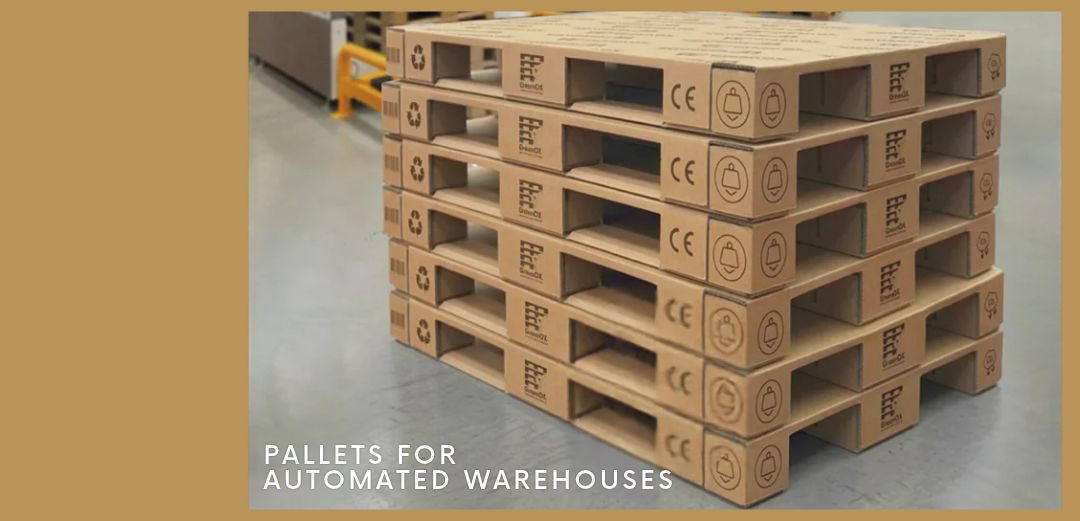
Pallets for Automated Warehouses: What to Evaluate Beyond Load Capacity
Warehouse automation changes the way pallets need to be evaluated.
In a conventional manual operation, an experienced operator can often compensate for small variations in a pallet, load or handling position.
Automated systems are less forgiving.
Conveyors, sensors, transfer points, pallet shuttles, robotic cells and automated storage systems work according to defined interfaces and tolerances.
For this reason, choosing a pallet for an automated warehouse requires more than asking:
“How many kilograms can it carry?”
Load capacity matters, but it is only one variable.
Automation requires predictable interfaces
Automated material-handling systems depend on repeatability.
A pallet may interact with:
- Roller conveyors.
- Chain conveyors.
- Belt systems.
- Pallet trucks.
- Forklifts.
- Automatic guided vehicles.
- Autonomous mobile robots.
- Robotic palletising or depalletising cells.
- Rack systems.
- Sensors and scanners.
Each interaction creates technical requirements.
Dimensions, deck geometry, fork-entry areas, support points and load distribution can influence whether the pallet moves correctly through the system.
A pallet that works perfectly on a warehouse floor may require a different evaluation when it is supported only by two rack beams.
A configuration that performs well under static storage may need additional validation when exposed to repeated dynamic handling.
Dynamic, static and racking loads are different
One of the most common mistakes in pallet specification is treating every load figure as equivalent. They are not.
Dynamic load refers to performance while the pallet and load are being moved or handled. Static load relates to the pallet when it is stationary and supported appropriately.
Racking introduces another condition because the pallet may be supported only at specific points, creating different bending stresses.
For automated warehouses, engineering teams should therefore avoid selecting a pallet using a single headline number.
They need to understand the exact condition in which the pallet will operate.
Load distribution matters
Two pallets carrying the same total weight may behave differently if the load is distributed differently.
A uniformly distributed load creates different stresses from:
- Concentrated boxes.
- Drums.
- Big bags.
- Machinery components.
- Loads with gaps.
- Products positioned mainly in the centre.
- Loads supported primarily around the perimeter.
Before integrating any pallet into an automated system, the actual load footprint should be reviewed.
The question is not only: “How heavy is the product?”
It is also: “Where does that weight act on the pallet?”
Support points and conveyor geometry
Automation introduces defined support geometry.
A pallet may travel over rollers, chains or transfer sections where only part of the base is supported at a given moment.
This can affect:
- Deflection.
- Stability.
- Transition between conveyors.
- Sensor detection.
- Load movement.
- Compatibility with mechanical stops.
For corrugated pallets, the structural design should therefore match the points at which the automated system supports the pallet.
This is why a pallet configuration validated for one conveyor layout should not automatically be assumed to behave identically on another.
Dimensional consistency
Automated systems work best with predictable dimensions.
Variability can create:
- Poor positioning.
- Conveyor jams.
- Detection problems.
- Inaccurate robotic pick points.
- Misalignment at transfer stations.
- Irregular rack placement.
Corrugated pallet technology can be manufactured with controlled dimensions and repeatable configurations, but the actual design still needs to be validated against the automation system.
The objective is not simply to make a pallet lighter.
It is to maintain the geometric consistency required by the process.
Fork entry and handling equipment
Even highly automated warehouses usually contain multiple handling methods.
A pallet may move through a conveyor system and later be handled by:
- A forklift.
- A manual pallet truck.
- An electric pallet truck.
- An AGV.
- An AMR.
- A loading-dock system.
Fork-entry geometry must therefore be evaluated across the complete journey.
Four-way entry can improve flexibility in many layouts, but clearance, tine position and equipment tolerances still need to match the pallet design.
Racking conditions need separate validation
A rack is not simply another storage location.
Open-beam racking can create significant bending stresses because the pallet may be supported only along narrow edges or beams.
Variables include:
- Beam spacing.
- Orientation.
- Load distribution.
- Storage duration.
- Temperature and humidity.
- Pallet configuration.
Green Ox configurations have been evaluated under defined test conditions, including rack-related scenarios.
But test results should always be linked to the tested pallet configuration and operating condition.
This is more useful than treating “rack compatible” as a universal label.
Environmental conditions still matter
Automated warehouses are not all dry, climate-controlled buildings.
Operations may involve:
- Cold storage.
- High humidity.
- Condensation.
- Temperature changes.
- Long dwell times.
- Food and beverage environments.
- Export staging areas.
Corrugated material is not immune to environmental conditions.
Humidity and exposure time should therefore form part of the technical assessment.
A correct pallet specification combines material selection, structural design and operating conditions.
Automation and lower pallet weight
Where the application is suitable, lower pallet weight can also influence automation indirectly.
Lighter empty pallets can reduce:
- Manual handling effort.
- Energy required for certain movements.
- Auxiliary transport weight.
- The burden of managing empty load platforms.
However, weight reduction only creates value when the pallet remains compatible with the system.
A lightweight pallet that causes handling problems is not an efficiency improvement.
Green Ox, Boix and scalable manufacturing
Green Ox approaches automation from two directions.
The first is pallet integration into modern material-handling environments.
The second is pallet manufacturing itself.
Together with Boix, Green Ox has developed automated pallet-forming technology. Depending on the production configuration, automated systems can reach rates of up to six pallets per minute.
This supports a decentralised production model in which patented Green Ox pallet technology can be manufactured closer to regional demand through qualified industrial partners.
For customers, this combines product engineering with a scalable manufacturing concept.
A practical checklist before changing pallet systems
Before introducing a new pallet into an automated warehouse, Engineering and Operations teams should review:
- Total load weight.
- Load distribution.
- Dynamic-load requirement.
- Static-storage requirement.
- Rack configuration.
- Conveyor type.
- Support points.
- Fork-entry requirements.
- Sensor and scanner positions.
- Robotic interfaces.
- Environmental exposure.
- Storage duration.
- Transport route.
- End-of-life model.
- Trial and validation procedure.
The strongest implementation projects are usually those in which the pallet supplier, automation integrator and end user evaluate the complete handling journey together.
Conclusion: automation rewards consistency
Automated warehouses make logistics more productive by reducing variability and increasing process control. The pallet needs to support that same objective.
Load capacity remains important, but dimensional consistency, support geometry, handling interfaces, rack conditions and environmental exposure can be equally important.
Green Ox develops different corrugated pallet configurations for different operating requirements, including models designed for dynamic loads from 300 kg up to 1,200 kg.
Contact Green Ox to evaluate your automated handling environment, load profile and operating conditions before selecting the appropriate pallet configuration.