Corporate sustainability is no longer a public relations exercise. It has become a critical financial, operational and governance indicator.
Global corporations, investors and strategic partners increasingly evaluate ESG criteria before consolidating commercial relationships. Within this framework, the carbon footprint associated with logistics and transport represents one of the most complex challenges to audit and reduce, particularly when it comes to Scope 3 emissions.
These emissions originate across the value chain and from external suppliers. They are often the highest and most difficult to control. This is where industrial packaging innovation becomes a strategic advantage.
The Hidden Environmental Impact of Traditional Load Supports
The life cycle of traditional load supports carries a significant environmental burden.
Wooden pallet pooling systems often require dedicated transport fleets for reverse logistics. In practice, this means trucks moving across regional and international routes with the sole purpose of returning empty wooden structures to their point of origin.
This process multiplies greenhouse gas emissions unnecessarily.
On the other hand, when companies use single-use load supports without an efficient recycling model, the environmental impact can contradict their own corporate sustainability policies.
For logistics, operations and sustainability leaders, the question is no longer whether packaging has an impact. The question is how quickly that impact can be reduced with measurable operational decisions.
The Circular Technology Response: Less CO₂, More Efficiency
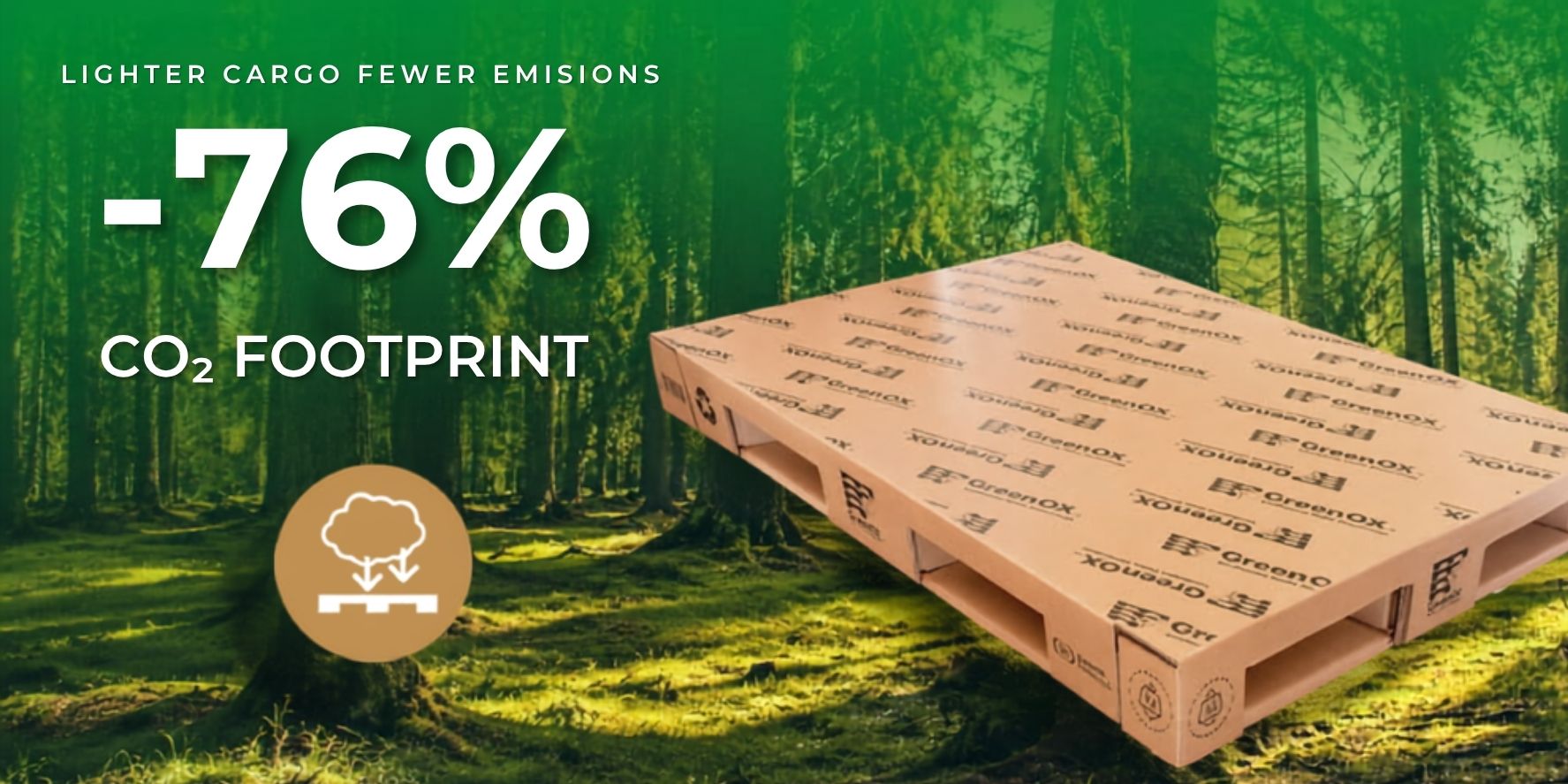
Replacing traditional pallet solutions with Green Ox corrugated cardboard pallets can reduce up to 76% of CO₂ emissions across the product life cycle compared with wooden pallet alternatives.
This reduction is achieved through three core pillars of circular logistics:
1. Lower Fuel Consumption
By reducing the total weight transported on each route, trucks and aircraft can operate more efficiently. Less weight means lower fuel consumption per kilometer and a more efficient use of transport capacity.
2. Responsible Sourcing
Green Ox pallets are manufactured using materials from sustainably managed sources, supported by internationally recognized certifications such as FSC.
This allows companies to align packaging decisions with responsible sourcing policies and ESG procurement requirements.
3. Zero Reverse Logistics
Once the pallet reaches its final destination, it does not need to be returned.
Instead, it can enter local cardboard recycling channels, becoming raw material again and generating residual value instead of additional transport costs.
This eliminates one of the most inefficient aspects of traditional pallet systems: moving empty structures back through the supply chain.
Leading the Transition Toward Greener Logistics
For Chief Sustainability Officers, ESG teams and senior executives, implementing Green Ox technology represents a direct and measurable quick win in decarbonization reporting.
It demonstrates that companies can optimize business performance while actively reducing environmental impact.
The future of global logistics belongs to companies that understand one fundamental principle: commercial efficiency and environmental responsibility are not opposing forces. They are two sides of the same strategic decision.
By lightening the supply chain with high-performance corrugated cardboard technology, companies can move toward a more circular, efficient and measurable logistics model.
Reducing Scope 3 emissions requires practical operational decisions, not only high-level sustainability commitments.
Green Ox corrugated cardboard pallets help companies reduce transport weight, eliminate reverse logistics and support circular material flows, while delivering measurable reductions in CO₂ emissions.
The transition toward sustainable logistics starts at the base of the load.
Contact Green Ox to discover how our pallet technology can support your ESG targets and reduce the carbon footprint of your supply chain.